The Esoteric Path: An Introduction to the Hermetic Tradition by Luc Benoist
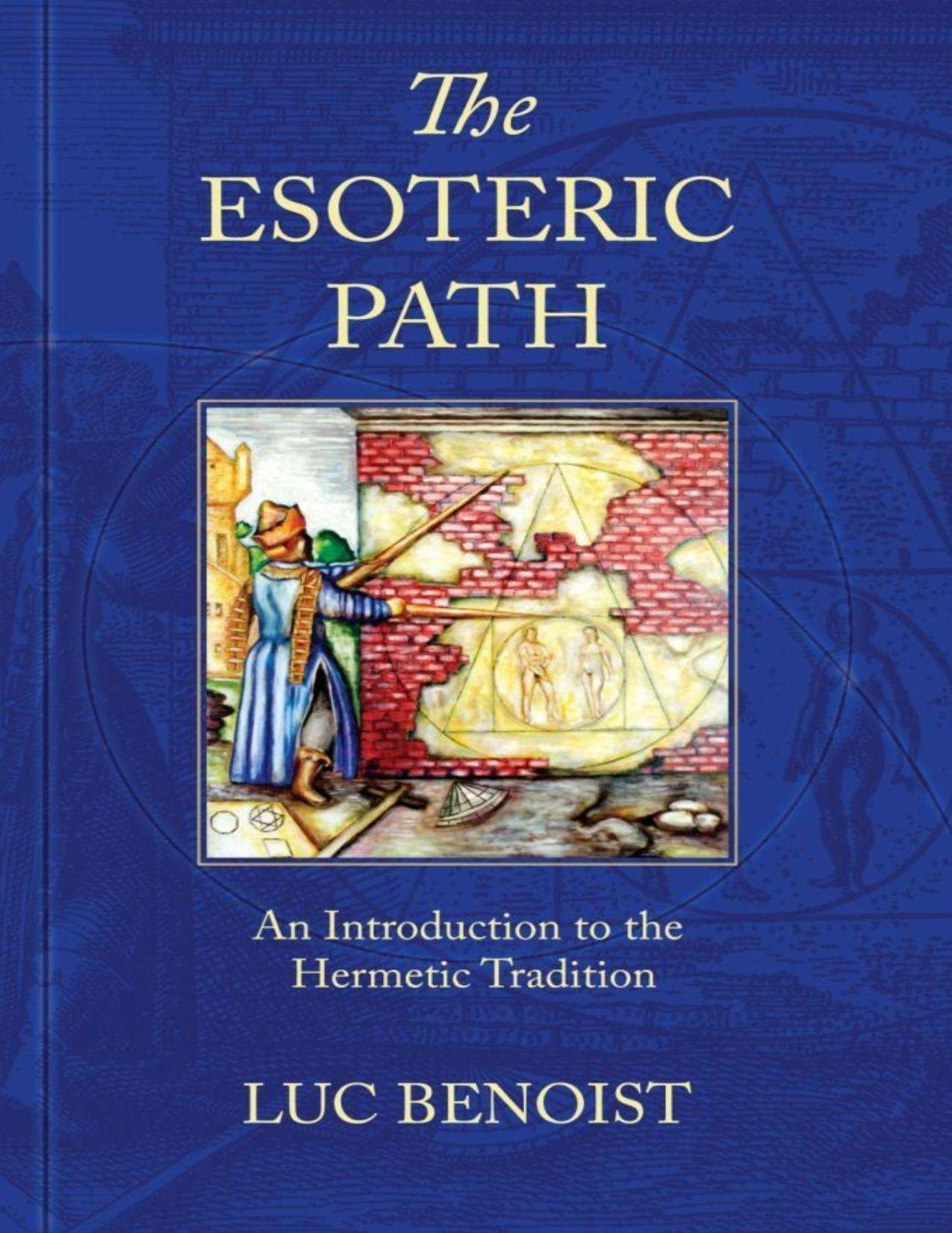
Author:Luc Benoist [Benoist, Luc]
Language: eng
Format: epub, pdf
Tags: General Fiction
Publisher: INgrooves
Published: 2004-08-25T22:00:00+00:00
CHINESE TAOISM
THE FAR-EASTERN TRADITION in its most ancient form is deemed to have originated with the legendary first Chinese Emperor, Fo-Hi, whose name denotes an intellectual function rather than an individual. He is said to have written three works, of which only one has come down to us, the I Ching or Book of Changes, which makes use of very simple graphic symbols consisting of unbroken and broken lines. It is said that in order to preserve in writing the teaching on the Primordial Tradition which he had received, Fo-Hi lifted up his eyes to heaven and then lowered them to the earth and wrote on his tablets the eight Kua, the fundamental symbols in the Chinese tradition. Each Kua, or trigram, is constructed of three lines, which are either continuous or broken, thus giving eight different combinations. The unbroken line represents yang, the positive pole and expansive power of manifestation; the broken line represents yin, the negative pole and contracting force of manifestation. These two poles yin and yang dominate all the classifications of Chinese science and are the elements of the primary duality which unite to form (or derive from) the Principial (metaphysical) Unity and which the Chinese call the Tao, that is to say the way or principle. Two Kua which are especially noteworthy, that which consists of three unbroken lines, symbolizing Active Perfection, and that of three broken lines, symbolizing Perfection in its Passive form. Two Kua superimposed form a six-line figure or hexagram. Since 64 different combinations are possible, the result-ing 64 hexagrams compose the simplest and completest metaphysical alphabet, the one used by Fo-Hi to compose the I Ching. It is so universal in character that it has been interpreted in many different, but not mutually exclusive, ways: astronomical, social, metaphysical, predictive, and so on. But the abstract nature of the hexagrams renders the book virtually untranslatable, and some form of initiation is necessary in order to understand it correctly. As a later Taoist writer said: ‘Ten will read, one will understand, ten thousand will not.’
So let us move forward to the sixth century BC to find a more accessible rendering of Taoist wisdom. It was at this period that the two complementary aspects of Chinese tradition, the exoteric and the esoteric, Confucianism and Taoism, were settled in a fashion that endured for many centuries. The Confucian aspect was concerned with external social relationships and the Taoist with the interior personal aspect. The great teacher of Taoism was Lao Tzu, who was archivist at the imperial court of the Chou dynasty. He left only one work, the Tao Te Ching, but the Kuan Yin Tzu or ‘Book of Concordant Actions and Reactions’ by his disciple Chuang Tzu contains much of his teaching. It is said to be influenced by Mahayana Buddhism.
The Tao is the Chinese name for the Principle. ‘There is one thing that is invariably complete. Before Heaven and Earth were, it is already there,’ says the author of the Tao Te Ching, which he begins by saying: ‘The Tao that can be expressed is not the eternal Tao.
Download
The Esoteric Path: An Introduction to the Hermetic Tradition by Luc Benoist.pdf
This site does not store any files on its server. We only index and link to content provided by other sites. Please contact the content providers to delete copyright contents if any and email us, we'll remove relevant links or contents immediately.
| Anthropology | Archaeology |
| Philosophy | Politics & Government |
| Social Sciences | Sociology |
| Women's Studies |
The remains of the day by Kazuo Ishiguro(9089)
Tools of Titans by Timothy Ferriss(8494)
Giovanni's Room by James Baldwin(7440)
The Black Swan by Nassim Nicholas Taleb(7198)
Inner Engineering: A Yogi's Guide to Joy by Sadhguru(6837)
The Way of Zen by Alan W. Watts(6673)
The Power of Now: A Guide to Spiritual Enlightenment by Eckhart Tolle(5855)
Asking the Right Questions: A Guide to Critical Thinking by M. Neil Browne & Stuart M. Keeley(5834)
The Six Wives Of Henry VIII (WOMEN IN HISTORY) by Fraser Antonia(5559)
Astrophysics for People in a Hurry by Neil DeGrasse Tyson(5226)
Housekeeping by Marilynne Robinson(4505)
Double Down (Diary of a Wimpy Kid Book 11) by Jeff Kinney(4338)
12 Rules for Life by Jordan B. Peterson(4331)
Ikigai by Héctor García & Francesc Miralles(4312)
The Ethical Slut by Janet W. Hardy(4309)
Skin in the Game by Nassim Nicholas Taleb(4308)
The Art of Happiness by The Dalai Lama(4170)
Skin in the Game: Hidden Asymmetries in Daily Life by Nassim Nicholas Taleb(4052)
Walking by Henry David Thoreau(4002)
